AI Through Glass

The AI museum Guided history

How did we get here?

A chessboard has clear rules. A picture has clues. A conversation can fool us. These rooms follow selected turning points since 1950 and the people who turned those puzzles into tests for machines.

Jump to a decade

1950–1973 The rule room

When intelligence was a question you could put to a machine

Start at a terminal. If a reply sounds human, what has the machine shown you? Early researchers tried to make that question precise. Some built programs that followed rules. Others questioned how far the demonstrations could travel.

Try sorting by a rule
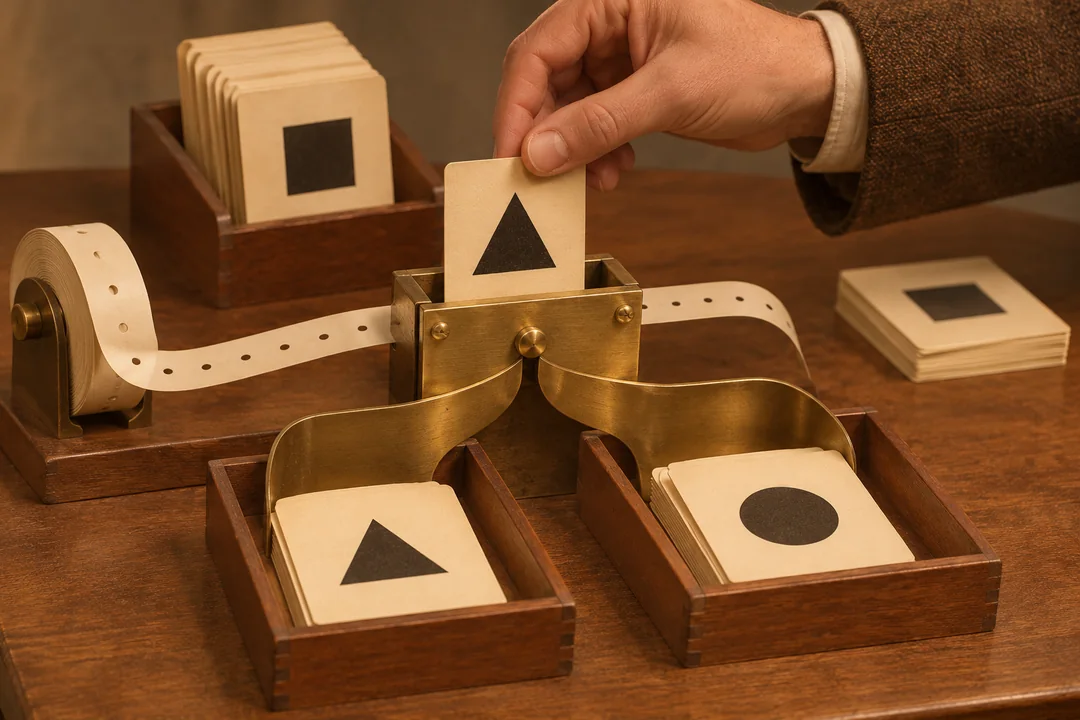
A hand holds a triangular card above a brass sorter. Triangles sit in its left tray, circles in its right, with paper tape behind.
Modern teaching illustration A rule fixes the route before a card arrives. Look for the equivalent of the sorter in ELIZA’s replies.
1950

Can a written conversation be a test?

Imagine two people in different rooms, exchanging typed messages. What could one reasonably infer about the other from the answers alone? Alan Turing proposed a version of this imitation game as a way to investigate machine intelligence. It gave his readers something they could actually try.

One conversation can show what persuaded a questioner. A convincing answer still needs to be checked for truth.

Look closer at the experiment

Turing’s starting game involved a human interrogator and two hidden respondents. He then asked what might change if a machine took one respondent’s place. The paper also considered machines that could learn.


1955–56

A summer project gives a question a name

John McCarthy, Marvin Minsky, Nathaniel Rochester and Claude Shannon put a proposal on paper in 1955. They wanted researchers to spend a summer exploring whether machines could use language, form concepts and improve themselves. In 1956 researchers gathered at Dartmouth. The phrase artificial intelligence was already in the proposal’s title.

Defining a field gave people questions to share. It left open how a machine might perform any particular task.

Read the dates separately

The proposal is dated 31 August 1955 and asks for a project in the summer of 1956. Keeping the dates separate shows the distance between a research ambition and the work that follows.

1966

A few words can sound like a listener

A person sitting at a terminal could type a worry. ELIZA’s therapist-style script might pick out a word, rearrange part of the sentence and turn it into a question. In his 1966 paper, Joseph Weizenbaum showed how this modest exchange could keep a conversation going.

A follow-up question can invite you to say more while revealing very little about what the program has grasped.

How the reply was made

ELIZA separated the program from the script. The script supplied keywords, patterns for taking a sentence apart, and patterns for putting a response together. Some earlier text could be saved for reuse.

1973

What happens when the puzzle gets bigger?

A method can look impressive on a small puzzle. Give it more pieces and the number of possible moves can grow too quickly to explore. In a review commissioned for Britain’s Science Research Council, James Lighthill pressed this objection. John McCarthy disputed his conclusions and argued that researchers already used shortcuts to narrow a search.

The disagreement leaves a practical question for anyone watching a demo: what happened when its makers made the task harder?

Why this was a dispute

Researchers called the growth of possible combinations a combinatorial explosion. Lighthill raised it as a barrier to moving beyond small problems. McCarthy’s response challenged the review’s picture of both the methods and the field.

1986–2016 The learning room

What if examples could do some of the teaching?

A designer can write a rule for a triangle. It is harder to write one for every leaf or every useful chess move. These exhibits follow different answers: adjusting a network, searching possible moves, collecting examples and combining learning with search.

Try teaching from examples
Two rows of glass slides show rounded leaves above slender leaves. A separate foreground slide holds a new leaf to classify.
Modern teaching illustration A learner sees labelled examples before it meets a new leaf. Which feature will it use, and what happens with an unfamiliar shape?
1986

Let the mistake change the next guess

Suppose a network guesses the wrong answer. Which of its many connections should change? David Rumelhart, Geoffrey Hinton and Ronald Williams described how to send information about the error backwards through a network. Repeated adjustments helped its inner layers pick up patterns useful for the task.

The choice of examples and the definition of an error still come from people. Getting better at that exercise leaves performance on a new one to be tested.

What travels backwards?

A training procedure measures how changes to the network’s internal settings would affect an error. It uses those measurements to adjust the settings. Read the neural network and training entries to follow the terminology.

1997

A rematch on the chessboard

Garry Kasparov lost the opening game of his 1996 match against IBM’s Deep Blue, then won the match. In their 1997 rematch the computer won. Its designers had built hardware to search possible moves and a way to score the positions it reached. On a chessboard, everyone agreed what counted as a win.

An agreed set of rules makes progress easier to judge. A victory at chess tells us little about how a system would handle an unfamiliar task.

Compare it with the previous exhibit

Deep Blue illustrates a different line of work from learning by adjusting a network. Its search was possible because chess specifies legal moves, turns and endings. Keep that distinction in mind when you reach AlphaGo.

2009–12

Give different machines the same picture test

If one team tested its system on dogs and another used street signs, whose recogniser was better? In 2009 Jia Deng, Li Fei-Fei and colleagues described ImageNet, a large collection of labelled images. In 2012 Alex Krizhevsky, Ilya Sutskever and Geoffrey Hinton reported strong classification results with a deep network trained on ImageNet using graphics processors.

The test asked for a label from a given set. An accurate label alone cannot tell a person what is happening in a scene.

Why the test matters

The paper reports errors on a held-out image set. A result has meaning because we know the examples, the possible answers and the scoring rule. Ask for those three things when you see a benchmark in a release note.

2016

Learning and search meet over a Go board

A Go player faces so many legal moves that looking equally closely at all of them wastes effort. AlphaGo learned from expert games and practice against itself. It used trained networks to guide a search of promising moves. In Seoul in 2016 it won its match against Lee Sedol, who won the fourth game.

A strong system can still lose a game. Here the board, legal moves and winning condition were unusually clear.

How it differs from Deep Blue

One network helped choose moves worth exploring. Another helped estimate the likely outcome of a position. Playing simulated continuations connected those estimates to the decision at the board.

2017–2026 The language room

From translating a sentence to asking a follow-up

Some of the machinery now behind chat interfaces was first tested on translation. Look at what changed as researchers moved from comparing translations to asking one model to attempt many tasks, and then put that model into a product.

Try choosing context
Six glass tiles form a line. The third glows gold and three arcs of different brightness connect it to later tiles.
Modern teaching illustration The lit links stand for different strengths of connection. This illustration makes the idea of attention visible. A real model computes many such relationships.
2017

Which other words change this word’s meaning?

When you translate a sentence, a useful clue can sit several words away. Ashish Vaswani and colleagues designed the Transformer around attention, a mechanism that lets a representation draw on other relevant parts of a sequence. Their original experiments centred on translation.

An attention weight expresses a relationship learned for a computation. It cannot, by itself, tell a reader whether a statement about the world is true.

A small change of perspective

Earlier translation models often processed a sequence one position at a time. The Transformer used attention to connect positions directly, making more of training possible in parallel. Its translation experiments give a specific context for those results.

2020

Show the task in the prompt

Instead of preparing a new version of a system for each task, what if you could show it examples in a message? The GPT-3 researchers tested a large language model on tasks this way. On some, sample questions and answers helped it continue in the requested pattern. The authors also reported tasks where it struggled.

A plausible continuation can match your format and still give the wrong answer. Test the output against something you already know.

Prompt examples and training

In the paper’s few-shot setting, the examples were given to the already trained model while it worked. Its learned settings were not updated for that task. This is a useful distinction when a product calls both activities “teaching”.

2022

A follow-up question becomes an interface

OpenAI released ChatGPT as a research preview. A visitor could ask for an explanation, object to part of the answer and ask again in the same conversation. The launch described using human feedback to help train the system, and warned that it could confidently produce incorrect answers.

A conversational answer can feel personal and assured. The burden of checking an important claim still falls on the reader.

Return to the opening room

Compare this interaction with ELIZA’s scripted questions. The underlying mechanisms differ, but both invite people to infer something about the speaker from the shape of the conversation.

2026

Read a release the way you read an exhibit

Consider two November records. Google listed Gemini 4 Hydrogen as generally available in its developer API. Its app had a separate rollout, with automatic selection for free users. The Grok Bot announcement described shared team bots and meetings, each with different plan conditions. Knowing the product, audience and date changes what a headline means.

Try it: could a free Gemini app user choose Hydrogen on demand just because the API was generally available? Open both records, find the access condition and explain your answer.

Apply the same habit to another lab

On the Grok Bot record, look up which plans could use Meetings. Compare that list with the plans for Team Bots. The date tells you when the published conditions applied.

Take the question with you.

The next time a system impresses you, ask what it was asked to do, what counted as success, and where that evidence ends.

Test that habit on a dated Gemini release

Return to the exhibition map ↑